
Why Montessori?
Why Montessori?
Let’s take a moment to reflect on your tamaiti/child. Are they curious about the world around them? Do they want to do things for themselves, often asking you to “help me do it myself” in their own way? Are they motivated to explore, challenge their minds and bodies?
I’m sure you were nodding along while reflecting on those questions and this is why you choose Montessori.

The Montessori Philosophy
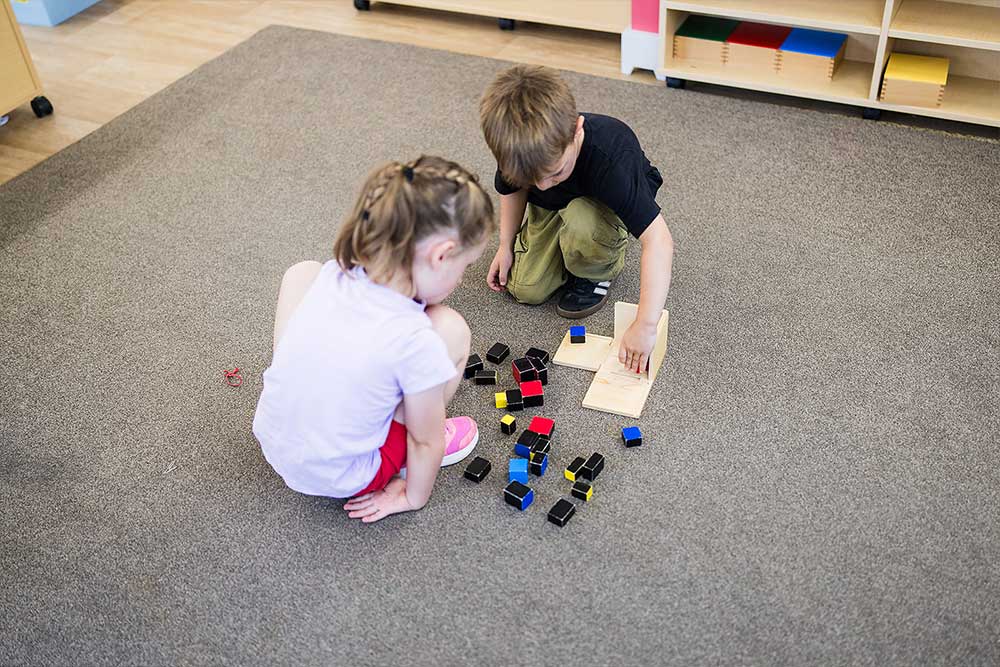
The Montessori Philosophy is more than shelves of beautifully curated materials, it is a combination of the environment, teacher and children working in harmony to encourage the child to develop to their potential.
A Prepared Environment
A Prepared Environment
Our Montessori prepared environment is one where each child’s interests, needs and developmental stages are intentionally and individually responded to. Each available activity, experience and material is thoughtfully prepared to cater to the tamariki in our class communities, supporting each child holistically. Our prepared environment uses real tools and hands-on opportunities to empower each tamaiti to feel capable, confident and independent.
Social Grace and Courtesy
Social Grace and Courtesy
We consider our classes, and school, as a community and value the important role of social skills in learning, growth and life. Through small group lessons, demonstrations
and responsive teaching, tamariki gain a strong understanding of what it means to interact with others with kindness, grace and trust. You can expect to be greeted by name and for your child to experience warm and consistently positive social interactions.
Quality, Experienced Kaiako
Quality, Experienced Kaiako
Our trained and experienced Montessori teachers are the link between each learner and the prepared environment. Kaiako observe and then apply vast knowledge of child development, deep Montessori understanding and years of experience to intentional planning of opportunities. Teachers guide tamariki to pursue their learning by being the link between the child and environment, where the aim is to be a guide and empower the tamariki to take ownership over their space and encourage them to work in harmony with others.
FAQs
Why do I have to come four mornings at 3 years old?
Research shows that children thrive in consistent environments where they know where to find their favourite activities, who their teachers are each day and that familiar friends will be there. By committing to four mornings a week, we have found children settle easily into their new routine comforted by the knowledge that they know what to expect each day.
Why do you have a mixed age range?
Through her thorough observations, Dr Maria Montessori recognised the benefits of older and younger working together. In Te Ao Māori, this concept can be referred to as tuākana-tēina. The older or more experienced child becomes the teacher, not only consolidating their own skills, but strengthening relationships and social understanding. The younger or less experienced sees all that is possible, is also growing their social competency and connecting meaningfully with the learning experience.
What do you do if a child only does the same activity or nothing at all?
It is the role of the Montessori kaiako to be curious and discover why. Observation and connecting with the family play an important role in helping to solve this question. There could be an inner need that is met through repetition of activity, so once that skill is discovered the child could be invited to explore activities also connected to this. If the child is finding it hard to choose something, observation will help us to look for the clues of what is restricting them or if there is a need the classroom is not meeting.
Why is there only one of each material?
One concern people have for Montessori is the lack of social development. This is a misconception. Social development as you will have read about is planned for and taught intentionally throughout the day, routines and grace and courtesy lessons. It is also inbuilt and inherent within the environment. Having one of each material is an example of this. In a Montessori classroom, there is no competition for resources or cries of “they’re not sharing!” Each child is guided/taught to return materials with consideration, “ready for the next person” you will hear us say. This means that other children interested in having their turn feel secure in the knowledge that everything they need to engage in that experience for themselves will be ready as soon as it becomes available. Patience, consideration and respect are practised and developed in this way.
Does this Montessori have a ‘ready for school’ programme?
The Montessori Philosophy was designed as an aid for life. So, while our environments are prepared with all the equipment available to teach literacy, numeracy and academic activities, this is more to meet the needs of children who want it rather than a curriculum that has set goals by the time they are five. We follow the interests of the child and connect them to the activities in the prepared environment. By simply being in the Montessori classroom tamariki build an inner confidence that they can follow a process, concentrate on a task, and succeed with what they set their mind to.
How do children explore the outdoor environment during their three-hour work cycle?
Our three-hour work cycle is from 8.00am to 11.00am and happens mostly inside the classroom, however this doesn’t mean the tamariki don’t go outside. Tamariki are welcome to move outside when they have a purpose for doing so. This could look like taking care of the environment by sweeping leaves or washing windows, collecting items such as cutting flowers for table displays or leaves to match with their biology activity, or helping the younger tamariki learn a game.
What does freedom mean in the Montessori environment?
The way we describe this concept is ‘freedom within a prepared environment’. Freedom to use means tamariki can choose whatever ‘activity’ they know how to do or move around their classroom space with self-discipline to leave others to work uninterrupted. Freedom means choosing to help others if they can or work on a shared project and listening to their body and choose when to care for their needs such as eating and toileting. The Montessori view is that freedom is a interweaving web of skills that include self-discipline, liberty, independence, responsibility and limits and it is the teacher’s job to support tamariki to develop these.
What is ‘cycle of activity’ and why is it important?
When you hear the term ‘cycle of activity’ this refers to the way tamariki work in the classroom. Firstly, they choose an activity that they have been shown, often setting up a mat or workspace in preparation for what they have chosen. They will then work through the steps they have been shown, using the materials with care, respect and their designed purpose. The final step is to pack it away, as they found it, ready for the next person to use it. This is an essential element in helping keep harmony and showing respect in the classroom, and no, children aren’t perfect at this, however it is something that they are supported to do as they grow and develop. If you encourage these skills at home, you too might see how they can tidy away when they have finished with an activity.
What can I do at home to help prepare my child for Montessori?
Slowing down routines as much as possible to allow children to learn skills such as putting on shoes, changing clothing and following instructions. Due to the nature of preschool environments, the ratio will change from home life, so children being able to try to care for themselves is a wonderful place for them to start seeing themselves as capable. Along with giving them the time to process and understand instructions means they can start to show initiative with their learning as we trust them to listen and communicate in their way.
Why do we have set visiting times, start times and ask parents to farewell/greet in the cloakroom?
These seemingly unrelated topics all connect with our need to protect children’s developing concentration, sense of wellbeing and belonging, and classroom harmony. The classroom belongs to the children and to provide the best learning environment we want to reduce disruption, interference and anything that will create disharmony. The kaiako who are in the classrooms are trained on how to be in Montessori environments, with mannerisms that go toward creating harmony, encouraging peace and knowing the needs of the current class. When parents visit or drop off/pick up it wouldn’t be realistic for them to understand all the essential elements that make Montessorians special teachers so we protect the class by booking in visits and drop off when they won’t interrupt and can be woven into the daily rhythm.